
Transformer Testing
GDRZ Transformer Winding Deformation Tester
Frequency response analysis (FRA) instrument that detects transformer winding deformation by swept-frequency measurement, using DDS digital sweep technology and dual 16-bit A/D sampling. Meets the technical conditions of DL/T911-2004.
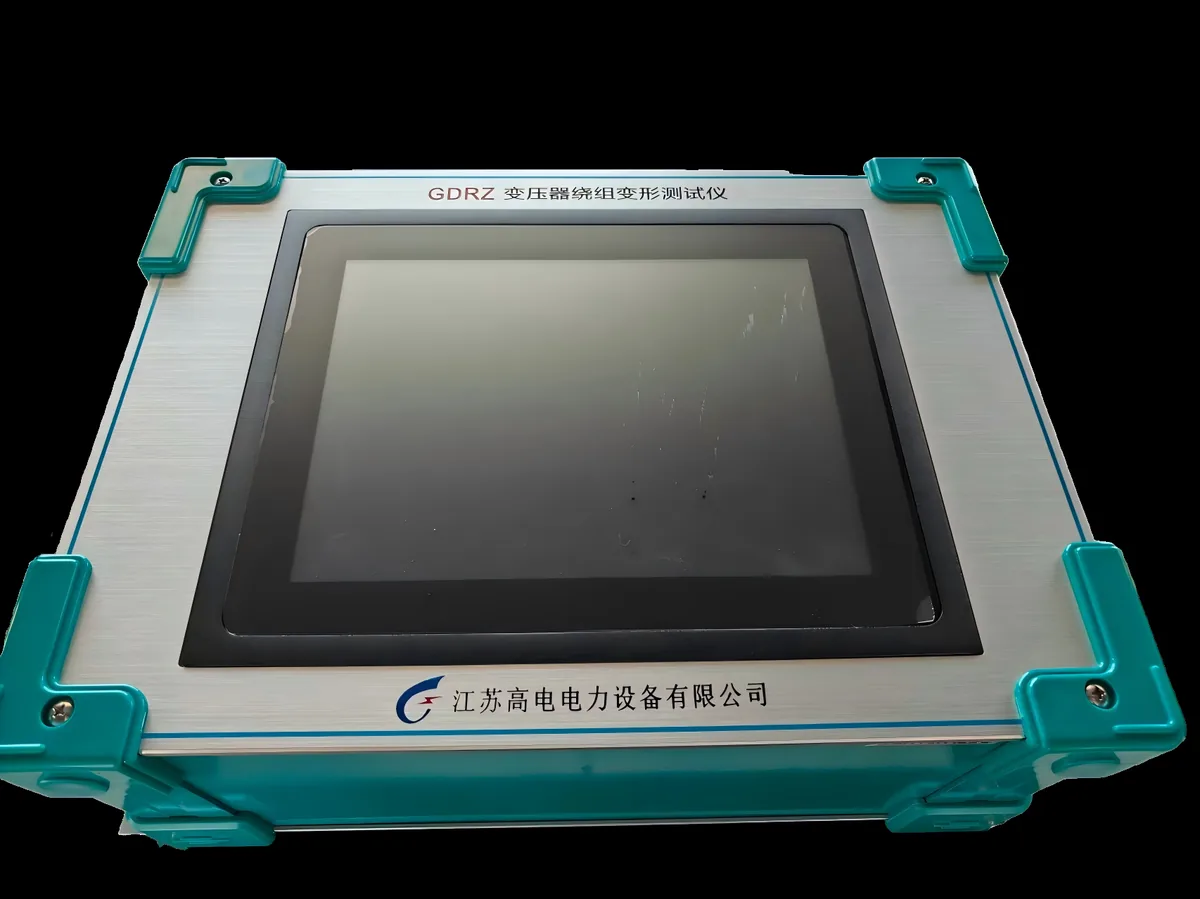
Overview
Frequency response analysis (FRA) instrument that detects transformer winding deformation by swept-frequency measurement, using DDS digital sweep technology and dual 16-bit A/D sampling. Meets the technical conditions of DL/T911-2004.
Standards & Compliance
Cited in this product’s specification
Benchmark standards for this equipment category
Systems in this category are commonly specified against these standards, linked to the issuing body. Final configuration and acceptance criteria follow the standard and edition you nominate.
- IEC 60076-1 — Power transformers - General
- IEC 60076-3 — Insulation levels and dielectric tests
- IEC 60076-5 — Ability to withstand short circuit
- IEEE C57.12.90 — Test code for liquid-immersed distribution and power transformers
- GB 1094 — Power transformers
- GB 50150 — Hand-over test of electrical equipment
Application Scenarios
Request Specifications & Quotation
Tell us your test object ratings, the test items you need and the applicable standards. Our sales engineers reply with a configuration proposal and a formal quotation within 24 hours.
Get a QuoteDetailed Description
Overview: based on the measurement of the characteristic parameters of the transformer internal windings, the transformer winding deformation tester uses the frequency response analysis (FRA) method for internal faults currently being developed and refined in the developed countries, and it can make an accurate judgement of transformer internal faults. The instrument quantifies the response variation of the transformer internal winding parameters across different frequency domains. From the magnitude of the change, together with the amplitude, region and trend of the frequency response variation, it determines the degree of change of the transformer internal windings, and from the measurement results it can then judge whether the transformer has already been severely damaged and whether it needs major repair.
For transformers already in service, regardless of whether frequency-domain characteristic plots were saved in the past, the fault severity can be judged by comparing the differences between the characteristic spectra of the coils of the faulty transformer. Naturally, if a set of the original winding characteristic plots has been saved, it is easier to provide a more accurate and powerful basis for the operating condition of the transformer, for post-accident analysis and for maintenance and repair. The instrument is built from a notebook computer and a single-chip microcomputer forming a high-precision measurement system. It has a compact structure and simple operation, with reasonably complete test and analysis functions, so it can be operated by following the user manual or after short-term training.
Features: acquisition control uses a high-speed, highly integrated microprocessor. The notebook computer communicates with the instrument over a USB interface, and a wireless Bluetooth interface is available as an option. The hardware core uses dedicated DDS digital high-speed sweep technology from the USA, so testing can accurately diagnose faults such as winding twisting, bulging, displacement, tilting, inter-turn short-circuit deformation and phase-to-phase contact short circuits. High-speed dual-channel 16-bit A/D sampling is used, and changing the tap changer during a field test produces an obvious change in the waveform curve. The signal output amplitude is adjusted in software to a maximum peak amplitude of 10 V.
Further features: the computer analyses the test results automatically and generates a Word electronic document. The instrument provides both linear sweep measurement and segmented sweep measurement, so it is compatible with the two measurement modes currently used in China. The amplitude-frequency characteristics conform to the national technical specification for amplitude-frequency characteristic testers. The horizontal axis, which is frequency, has both linear and logarithmic scaling, so the printed curve can be either linear or logarithmic as the user requires.
Analysis: the detection data automatic analysis system performs a horizontal comparison between phases A, B and C for winding similarity, returning very good consistency, good consistency, poor consistency or very poor consistency. It performs a vertical comparison of A-A, B-B and C-C, retrieving the original data and the current data for the same phase to compare winding deformation, returning normal winding, mild deformation, moderate deformation or severe deformation. A Word electronic document is generated automatically for saving and printing.
Standard: the instrument fully meets the technical conditions of the power standard DL/T911-2004, Frequency Response Analysis Method for Winding Deformation of Power Transformers.
Technical Specifications
| Linear sweep measurement range | (10 Hz) – (10 MHz), 40000 sweep points |
|---|---|
| Linear sweep resolution | 0.25 kHz, 0.5 kHz and 1 kHz |
| Segmented sweep measurement range | (0.5 kHz) – (1 MHz), 2000 sweep points |
| Segmented sweep bands | (0.5 kHz) – (10 kHz); (10 kHz) – (100 kHz); (100 kHz) – (500 kHz); (500 kHz) – (1000 kHz) |
| Amplitude measuring range | (-120 dB) to (+20 dB) |
| Amplitude measuring accuracy | 0.1 dB |
| Sweep frequency accuracy | 0.01% |
| Signal input impedance | 1 MΩ |
| Signal output impedance | 50 Ω |
| Signal output amplitude | ±20 V |
| Signal output amplitude (software adjustable) | Maximum peak amplitude ±10 V |
| Same-phase test repeatability | 99.9% |
| A/D sampling | High-speed dual-channel 16 bit |
| Sweep technology | Dedicated DDS digital high-speed sweep (USA) |
| Computer interface | USB; wireless Bluetooth optional |
| Instrument dimensions (L x W x H) | 300 x 340 x 120 mm |
| Aluminium case dimensions (L x W x H) | 310 x 400 x 330 mm |
| Total weight | 10 kg |
Frequently Asked Questions
How does the GDRZ detect winding deformation?
Can it be used on transformers with no stored baseline?
How are the results analysed and reported?
Further Reading
Method and selection guides that cover the tests this instrument performs.
Transformer Winding Deformation Testing: Methods and Standards
A short circuit, a road journey or years of load cycles all leave their mark on a transformer winding. This guide compares the main detection methods and how to interpret their results.
IEC / IEEE / GB Standards Cross-Reference for High-Voltage Testing
Which standard governs a high-voltage test? This reference maps transformers, CTs and PTs, partial discharge and FRA to their IEC, IEEE and GB/DL documents.
Reviewed by the Application Engineering Team at Nanjing Gaodian Electric Power Equipment
Specifications are taken from the manufacturer’s technical documentation. Final configuration and acceptance criteria follow the standard and edition you nominate — tell us your test list and we will confirm the ratings.
Related Products
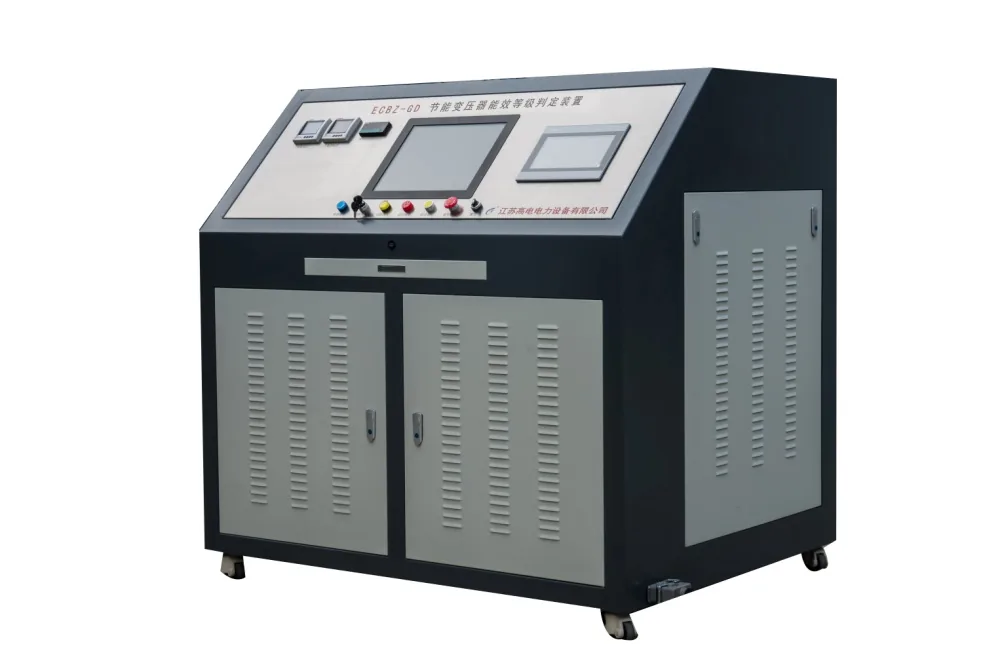
ECBZ-GD Energy-Efficient Transformer Energy-Grade Evaluation System
Automatic evaluation system for the energy-efficiency grade of distribution transformers up to 800 kVA at 10 kV/0.4 kV. Combines intelligent test sequence control, automatic wiring changeover, data processing, data upload and report generation in one bench.
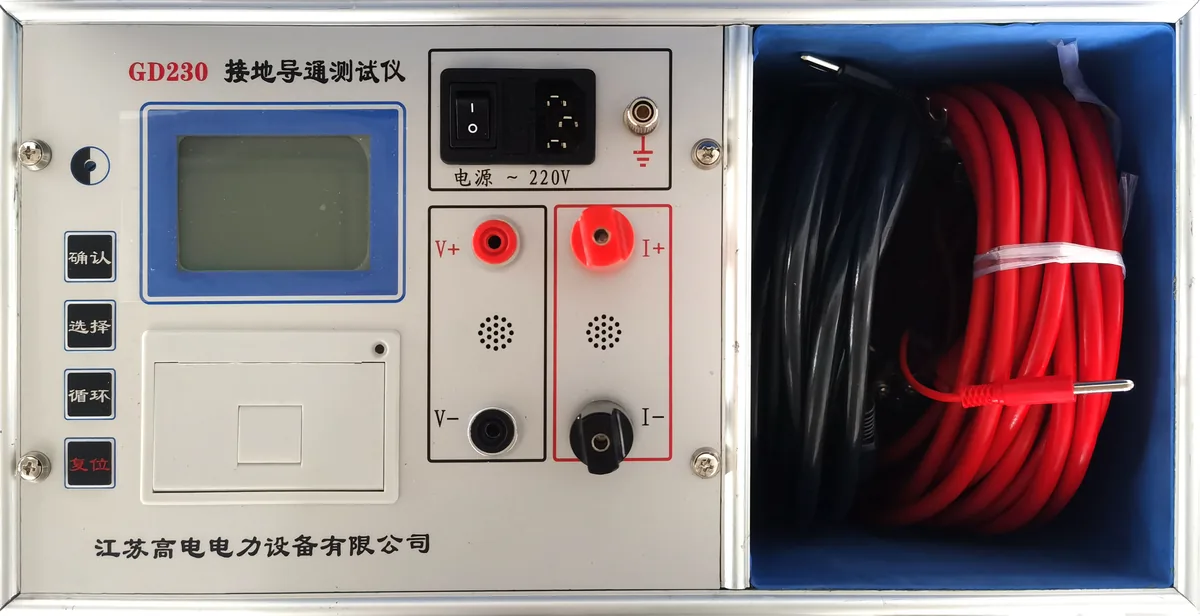
GD230 Ground Continuity Tester
Portable instrument for measuring the continuity resistance between the grounding down conductors of individual items of equipment in a substation. Controlled by a high-performance MCU with automatic current selection, on-board data retention and a thermal printer.
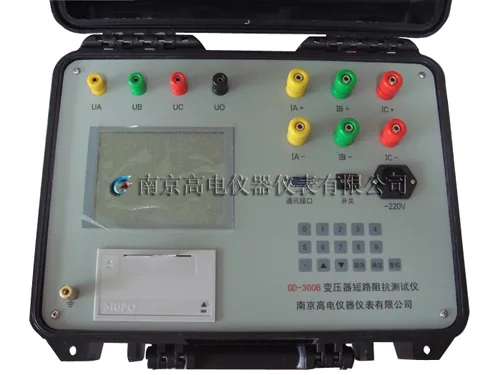
GD-300B Transformer Short-Circuit Impedance Tester
Measures transformer short-circuit impedance, short-circuit reactance, short-circuit resistance and three-phase impedance voltage. Uses dual A/D synchronous AC sampling and DSP for winding deformation assessment in the field.
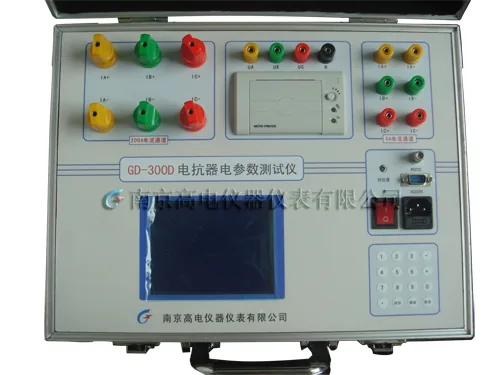
GD-300D Reactor Electrical Parameter Tester (Portable)
Portable instrument dedicated to measuring the electrical parameters of single-phase and three-phase reactors, including AC phase voltage RMS, average voltage, current RMS, active power, reactance and inductance, at 0.5 class accuracy.
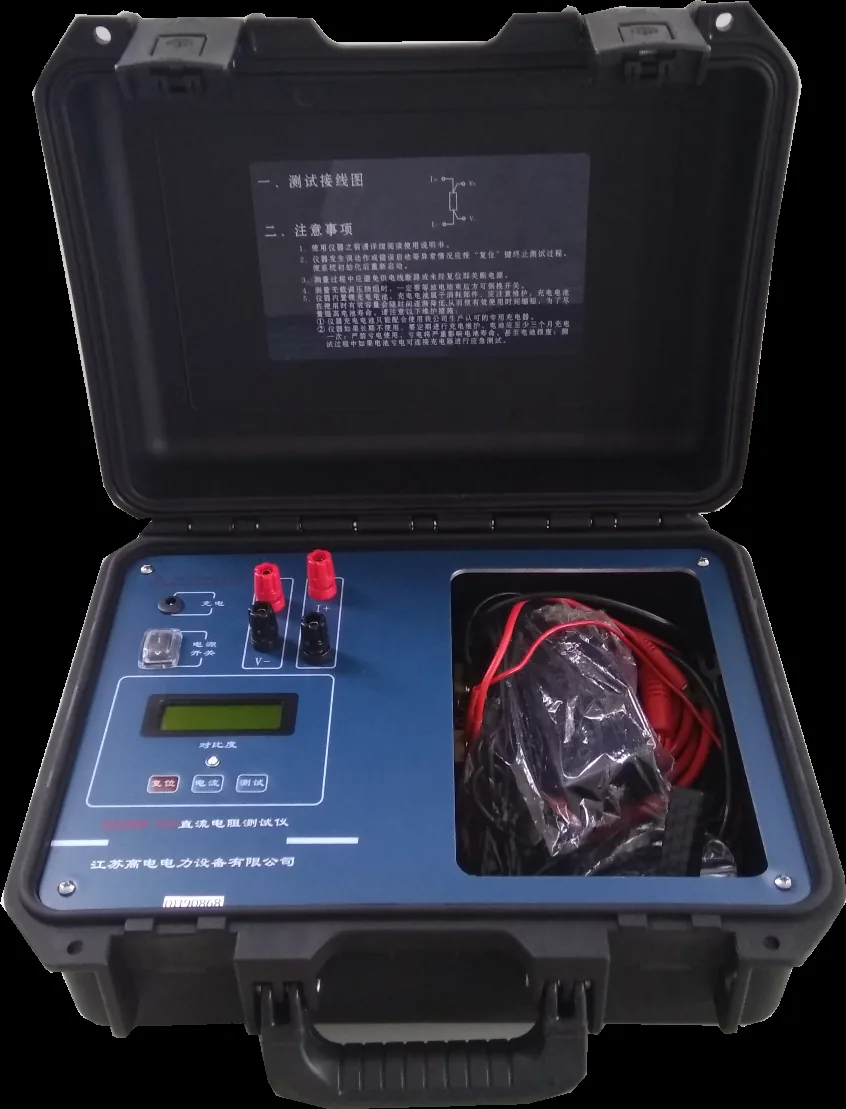
DC Winding Resistance Tester
Portable instrument for DC resistance measurement of inductive equipment such as transformers, motors and instrument transformers (CT/PT). Fully software-controlled with back-EMF protection and field anti-interference capability.
GD-300D Reactor Electrical Parameter Tester (Built-in)
Panel-mounted version of the GD-300D reactor electrical parameter tester, using a 320 x 240 dot-matrix LCD with multi-screen menu operation and direct measurement of three-phase reactance, inductance and total active power.
More in Transformer Testing
- •ECBZ-GD Energy-Efficient Transformer Energy-Grade Evaluation System
- •GD-300B Transformer Short-Circuit Impedance Tester
- •DC Winding Resistance Tester
- •GD-400A Transformer Capacity & No-Load Loss Tester
- •GDBZ-IV Transformer Test Bench
- •GDBZ-III Transformer Comprehensive Test Bench
- •Transformer Intelligent Logistics Line Test System
- •GDBZ-IV 220/110kV Main Transformer Comprehensive Test System
- •GDBZ-IV Automatic Transformer Comprehensive Test System
- •GD700A Automatic Turns Ratio Tester
- •GD-810 Transformer On-Load Tap-Changer Tester
- •GD200-40WA Dual-Channel DC Winding Resistance Tester
- •GD300C Power Analyzer
- •GD-700 Automatic Turns Ratio & Vector-Group Tester
Need the datasheet for this model?
Send us this product name plus your test requirements. We reply with specifications, photos and a formal quotation.